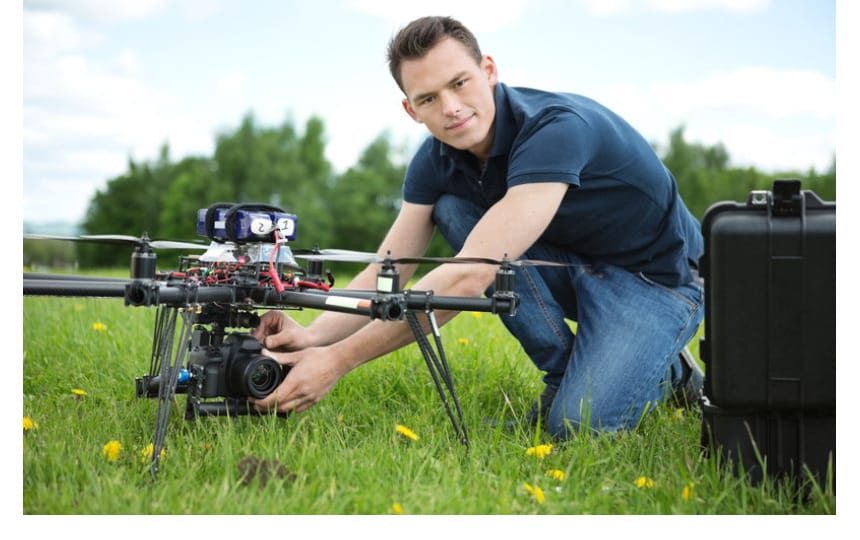
2016-12-04:- UAVs / Drones – so what’s all that about then?
The rapid emergence of drone technology concerning battery life, lighter weight components and more robust control software mean this platform can now seriously benefit the Rope Access industry. Lighter airframes mean greater payloads and longer operational air-time.
Drones now present a serious option for Rope Access companies to offer accelerated initial surveys for their existing client base.
Companies with a drone capability can visit a site (onshore or offshore) and quickly deploy a drone to carry out a site survey with a skeleton crew in the shortest possible time – minimal equipment set up is a major advantage...
Won’t this be bad for the Rope Access industry?
...Rope Access teams can then be sent to access the site to carry out the work.
The client benefits in two ways:
1) Fewer personnel on the initial survey
2) Faster deployment and collation of initial survey data
The above is a particular advantage in the offshore environment, where time and bed space are at a premium.
What are the advantages for Rope Access companies in having their own Drone Department?
Essentially, it’s cheaper, easier and therefore more efficient for the client. Rather than hiring a bespoke ‘drone only’ company... this one-stop-shop approach is already a familiar part of a lot of Rope Access company business models.
What about certification for the pilots?
Current certification is “Permission for Aerial Work” (PFAW) qualification. The UK Civil Aviation Authority states:
The PFAW is split into four different classes and these are defined by aircraft type and aircraft weight:
• Rotary 0–7kg
• Rotary 7–20kg
• Fixed Wing 0–7kg
• Fixed Wing 7–20kg
To be granted a PFAW the operator must:
• Demonstrate Pilot competence
• Submit Operations Manual
• File PFAW Application – CAA Form SRG1320
The theoretical knowledge portion applies across all classes.
What about the costs for the hardware?
Costs have reduced considerably... Hardware is hugely variable, from smaller (yet very capable) drones sub £1K to the more expensive commercial side which can top £20K+. A typical SkyJib 8 Octocopter "Hollywood Heavy Lifter" (airframe only) costs about £2K.
What is the typical location where they can be used?
Areas of use are still expanding. Typical locations include:
• Bridges
• Viaducts
• Offshore Oil/Gas Installations
• Rail Infrastructure Projects
• Building Inspection/Maintenance
Can they only be used outside?
Amazingly, no! There have been examples of drones surveying storage tanks, blister tanks and other confined spaces.
What services can they provide?
• Dimensional surveys
• Live feeds for logistics planning
• Thermal Imaging
• Volumetric surveys
• Visual surveys
Drone usage enhances Rope Access companies’ capabilities while reducing fall risk exposure.
An additional benefit: public familiarity with drones increases the visibility of Rope Access companies. This article is meant to trigger discussion.
Feel free to leave your comments in our UAV Facebook group here:
Drone Jobs and Training